LoonWatch volunteers have many options for joining VCE in the conservation of Common Loons. Whether you live alongside a lake or only occasionally visit your favorite pond, here are a few volunteer options:
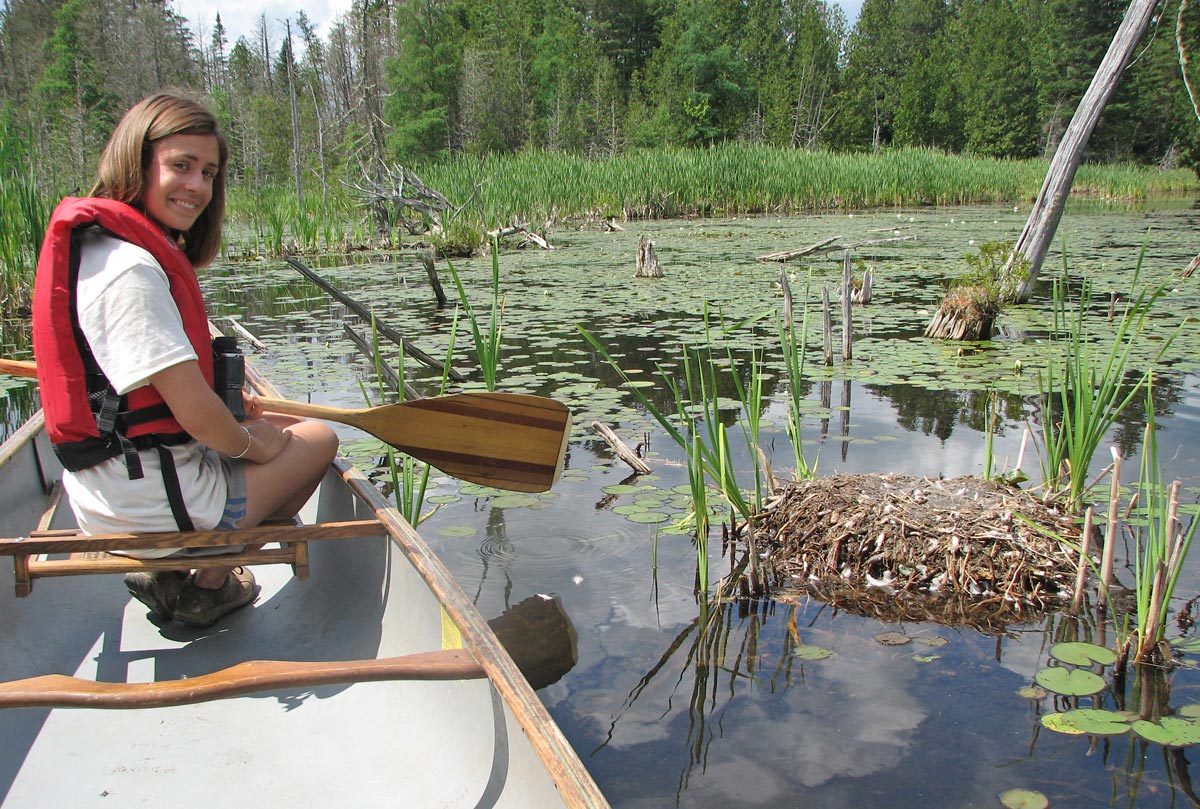
LoonWatch volunteer Shannon Maes on Lyford Pond
Annual July LoonWatch
Survey a lake for one hour on the third Saturday of July—or if you’ve got time, survey a few lakes. On this single day, we cover more than 160 lakes and ponds statewide each year. It’s the single most effective way for VCE to document and track breeding loons across the state. Our next July LoonWatch will be in July of 2024. To get an assignment for the annual LoonWatch, contact our loon biologist, Eric Hanson. Eric keeps a list of lakes where we need volunteers. (Note that this list will change as lakes are assigned or become available.)
- How to Report Your LoonWatch Results to Vermont eBIrd (preferred) (PDF) (Video Tutorial)
- LoonWatch field data form (PDF)
- List of LoonWatch Lakes and Assigned Volunteers (PDF) (updated 6/24/2022)
- Here is the same LoonWatch Lakes and Assigned Volunteer form that is sorted by volunteer last name
Adopt-a-Lake
On lakes with nesting pairs or other known loon activity, volunteers monitor loons weekly or every two or three weeks from mid-May through August. On lakes with loon activity but no nests, volunteers visit and monitor the pair one to four times a month from mid-May to mid-July. This program is great for folks who have summer camps on lakes or live nearby. More than one volunteer can adopt a lake. Read this introduction letter from Eric Hanson, and contact Eric for more information.
- The Adopt-a-Lake Reporting paper form
- Volunteer Hours Form
- How to Report Your LoonWatch Results to Vermont eBIrd (preferred) (PDF) (Video Tutorial)
Focused Loon Surveys
Help us fill in the gaps on lakes and ponds where we could use more loon surveys. Is there a pair present this year? Has the pair nested yet? Are they still on nest? Have the chicks hatched out? Did the chicks make it through the summer to fledging age? We also want surveys from lakes where loon activity is not well documented. Do loons even use a specific pond or is a pair possibly forming? Knowing which ponds loons do not use helps us guide our efforts.
These focused loon surveys are ideal for people who like to get out to lakes but may not have the time to consistently observe a lake throughout the summer. You can go at any time and report your sightings on Vermont ebird or directly to the VLCP coordinator. It’s a great excuse to explore new areas or visit favorite haunts. Volunteer data recording documents are listed below. The “all season” list is comprehensive. The other lists are a subset of the “all season” list and will be updated occasionally as surveys are reported.
- Focused Loon Surveys – Instructions
- Focused Loon Surveys – Lake List
- How to Report Your LoonWatch Results to Vermont eBIrd (preferred) (PDF) (Video Tutorial)
Loons on Vermont eBird
Any loon sighting is worth recording for science. Whether you join a LoonWatch effort or not, please add your loon encounters to the growing collection of data contributed by casual and expert birders alike on Vermont eBird.
- How to Report Your LoonWatch Results to Vermont eBIrd (preferred) (PDF) (Video Tutorial)
Volunteer Hours Reporting Form
Our work on loon conservation is supported by a matching grant. Reporting your hours helps us to fulfill this grant and conserve loons.