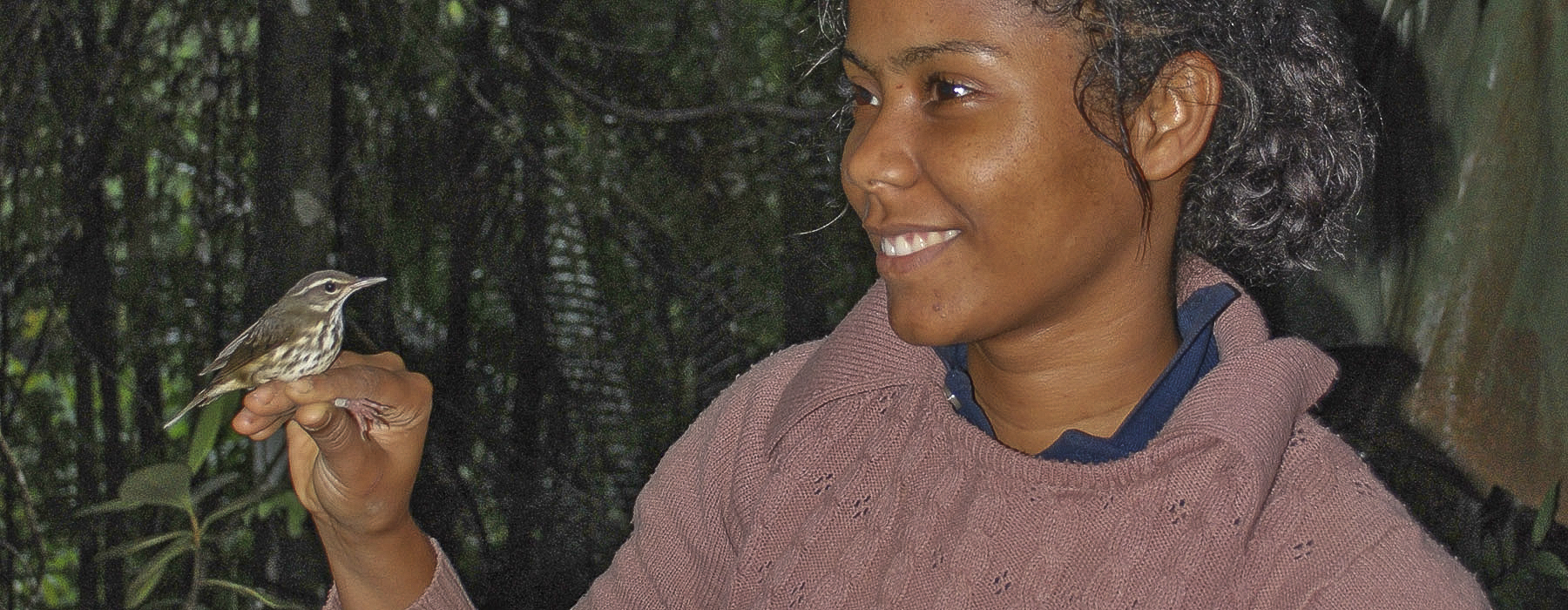
Training of our local partners in the Dominican Republic and Haiti is among the most important facets of VCE’s overall conservation program on Hispaniola.
For over two decades we have worked closely with local biologists, students, and amateur ornithologists, helping to build their capacity in becoming ecological stewards of Hispaniola’s unique biodiversity. Like the migratory birds passing back and forth that bind us together, we've hosted Caribbean biologists here in the Northeast too.
We’ve worked with dozens of organizations and trained many students and biologist. Here are a few examples of our work:
- Thanks to a John D. and Catherine T. MacArthur Foundation grant for capacity building on Hispaniola to our colleague Eduardo Inigo-Elias at the Cornell Lab of Ornithology, VCE was able to invite 10 Dominican students to participate in our workshop. Our Dominican colleagues further invited one Cuban student to join the team. We couldn’t have found a more enthusiastic, engaged, and absorptive group. With 3 seasoned Dominican and 3 VCE trainers providing a high student:trainer ratio, we immersed the participants in diverse aspects of field work.
- A group of 11 Dominican conservationists led by VCE colleague Chuck Kerchner, spent a week-long exchange that took them from Boston to Burlington, across Lake Champlain to Lake Placid, and back to Stowe. They joined ~50 people at Topnotch Resort to learn about and celebrate the “Two Countries – One Bird” initiative, in which VCE has been a partner from the start. A presentation on the ecology of Bicknell’s Thrush captured everyone’s attention, as did Chuck’s overview of pioneering collaborations on Reserva Privada Zorzal, the DR’s first-ever private reserve, which many of the partners helped to create. First-class, sustainably-grown chocolate from the Reserva was available to taste and buy, and many enthusiastic conversations took place.
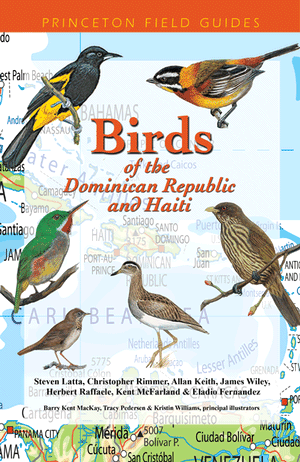 Roger Tory Peterson launched a bird watching revolution in North America with his unique field guide to birds in 1934. We aimed to do the same on Hispaniola with an in-depth and modern field guide written not only in English, but in Spanish and French too. This is the first comprehensive and fully-illustrated guide to cover the birds of this biologically rich island. Our approach to production of this field guide takes advantage of the recently published guide to the birds of the West Indies, the new annotated checklist of the birds of Hispaniola, and our own data on the biology and ecology of Hispaniolan species, to create a comprehensive guide to the more than 300 species of birds found on the island. Color plates from Raffaele et al.’s guide to the birds of the West Indies were used, and new plates of all 31 endemic species were painted by the Canadian artist Barry MacKay.