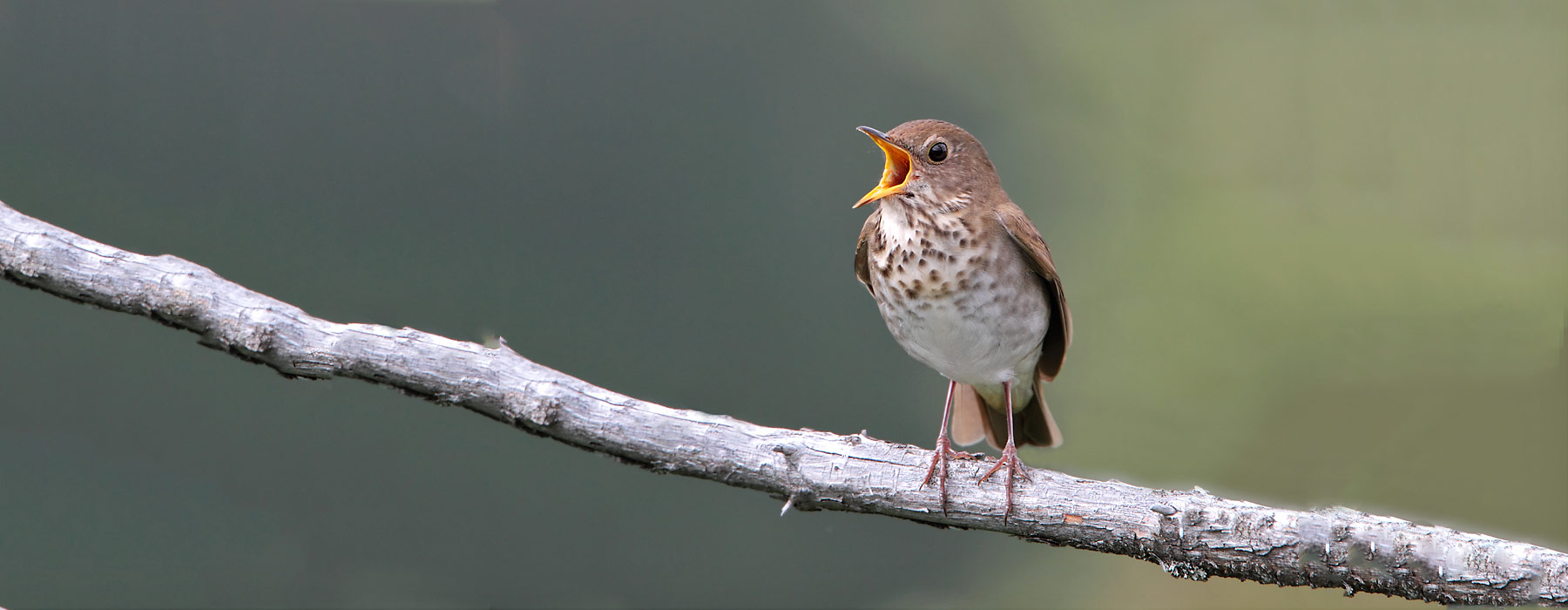
The winter habits of Bicknell’s Thrush, one of North America’s most rare and vulnerable migratory songbirds, have long been a mystery.
VCE’s long-term commitment to Bicknell’s Thrush conservation demands that we pay careful attention to issues on its winter range. For over 20 years we have been unraveling its elusive winter ecology for conservation.
 Historical records, while scant, suggested that the species winter range was restricted to the Caribbean Greater Antilles. VCE’s studies of the species’ breeding ecology and conservation status in the Northeast naturally led us to investigate the non-breeding period of its annual cycle. An exploratory trip to the Dominican Republic by Chris Rimmer in 1994 confirmed the presence of Bicknell’s Thrush in high- elevation, broadleaf forests of Sierra de Bahoruco and catalyzed a 3-year study of the species’ distribution and habitat use. Surveys by VCE and colleagues on other Caribbean islands leave no doubt that Hispaniola constitutes the core winter range of Bicknell’s Thrush.
Although Bicknell’s Thrush have been found in the Blue Mountains of Jamaica, the Sierra Maestra of Cuba, and Puerto Rico’s Luquillo Mountains, VCE believes that 90% or more of the species’ global population is concentrated on Hispaniola. Our surveys have shown that wet broadleaf forests with a dense understory are the habitat of choice. Although we have documented Bicknell’s Thrush in humid forests at sea level, extremely few of these habitats have escaped loss or alteration by humans. Montane forests in the Dominican Republic and Haiti constitute the primary winter refugia for Bicknell’s Thrush. Even these remote habitats face unrelenting loss from intense human population pressures on the island.
VCE’s long-term commitment to Bicknell’s Thrush conservation demands that we pay careful attention to issues on its winter range. Since 1994, we have attempted to unravel the species’ elusive ecology on Hispaniola. Annual monitoring at a protected forest site in Sierra de Bahoruco has shown stable overall numbers of birds captured in mist nets, despite considerable year-to-year fluctuations. Our more intensive field research has revealed some fascinating and important insights. Foremost among these is that male and female Bicknell’s Thrush appear to segregate by habitat type. In undisturbed, primary forests of Sierra de Bahoruco, males outnumber females by a 4:1 ratio. Both sexes maintain discrete territories throughout the winter, and insect food resources are relatively rich in these forests, which we believe represent “optimal” winter habitat.
A different situation exists at our study site in the Cordillera Septentrional, a mid-elevation, much wetter area that features more disturbed, secondary broadleaf forest with a relatively open understory. Here females slightly outnumber males, and birds appear to feed more heavily on fruit, a generally lower quality food than insects. We suspect that these forests constitute “suboptimal” habitat, and that, because suitable habitat is limited islandwide on Hispaniola, females may have few options but to inhabit them. The consequences for female survival could be pronounced, with effects on the entire species’ viability. Adding insult to injury is our discovery that introduced rats may cause significant mortality during winter, even in the relatively pristine forests of Sierra de Bahoruco.
We have much work ahead to better understand the winter ecology of Bicknell’s Thrush, and thus conserve its crucial non-breeding habitats. The situation is complex and worrisome, but we are hopeful.