Bobolink Winter Ecology

Hot off the press:

Renfrew, R., A. M. Saavedra. 2007. Ecology and conservation of Bobolinks in rice production regions of Bolivia. Ornitologia Neotropical 18:61-73.

Renfrew, R. 2007. An interspecific foraging association between Nearctic-Neotropical Migrant Passerines in Bolivia. Wilson Journal of Ornithology 119:124-126.

Gaps in our knowledge about the wintering ecology of grassland birds limit the effective conservation of several species that have undergone population declines. The Bobolink (Dolichonyx oryzivorus) is a case in point. Bobolink populations have suffered dramatic declines and a concurrent range contraction throughout North America during the last four decades (Sauer et al. 2001). Although population declines are undoubtedly due in part to changes in land use on the breeding grounds, threats on the wintering grounds are unknown. Basic information about their wintering ecology such as distribution, habitat use, and potential conservation threats is just beginning to receive attention in the ornithological community.

During fall migration, the Bobolink was historically considered a pest to rice farmers in the southeastern U.S., reflected in its Latin name, “devours rice.” Recent evidence from South America indicates that the Bobolink continues to earn this reputation on its wintering grounds. However, there have been no studies to characterize its use of rice and the potential consequences for its conservation.

The main objective of this project is to determine Bobolink distribution, habitat use, and foraging ecology in the winter, in order to assess the potential conservation threats to populations. The project includes a special focus on Bobolink use of rice fields and associated conservation issues. Rosalind Renfrew is working with collaborators in Paraguay, Bolivia, and Argentina to advance our knowledge of Bobolink wintering ecology with the ultimate goal of developing specific conservation recommendations in South America.

Background

The Bobolink is a unique species for its size, making one of the longest annual migrations of the New World passerines, a 12,000 mile round-trip between North and South America. The avian and conservation communities have acknowledged that a holistic approach to conservation of Neotropical migrant birds requires increased attention to the ecology of species during their nonbreeding season (Sherry and Holmes 1992, Vickery and Herkert 2001, Donovan et al. 2002).

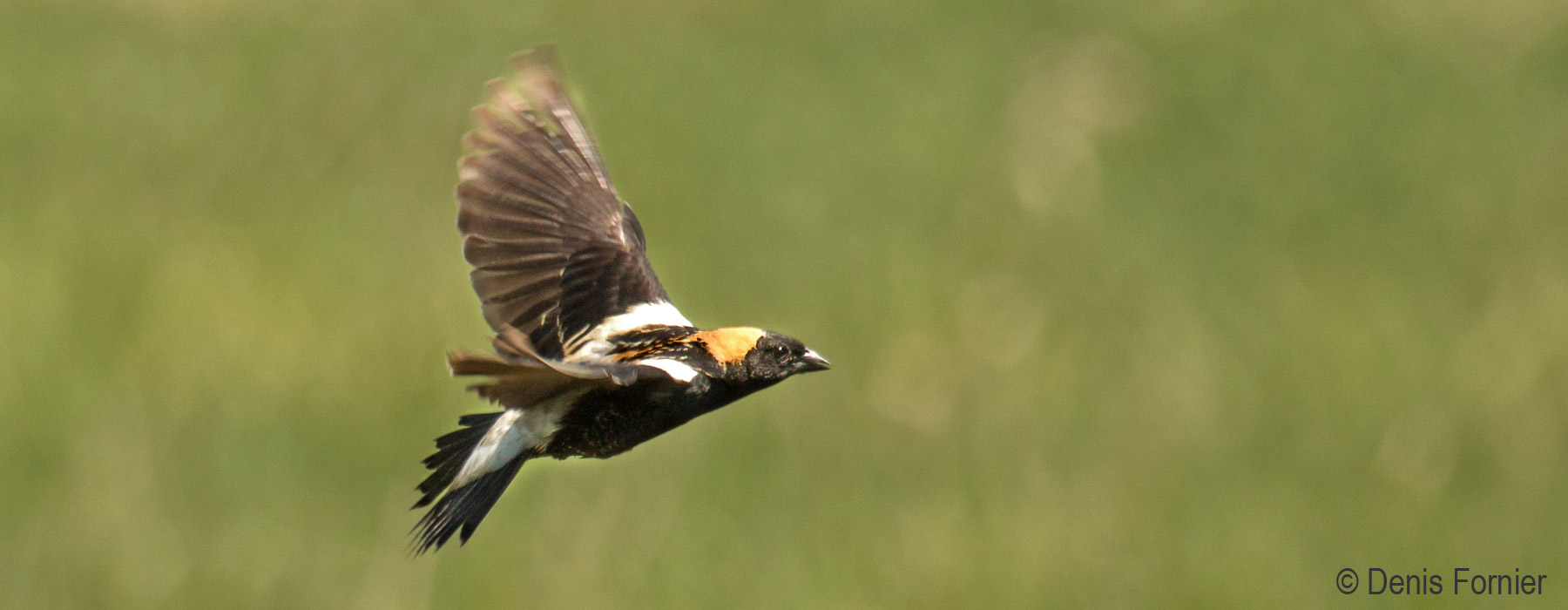
Their bubbly songs and flashy yellow-and-white on black colors make Bobolinks a highly visible and popular bird during the breeding season. Remarkably, however, their winter life is still a mystery. We know that they feed in large flocks in both native grasslands and in agricultural fields, approximately in the center of South America (Martin and Gavin 1995). But native grasslands and forests in South America are being rapidly converted to crops. As these trends continue, a larger proportion of the Bobolink population is likely to rely on crops for foraging, intensifying potential threats to their populations on agricultural lands.

The ill-effects of pesticides used in agriculture in South America have already been documented for migratory species such as the Swainson's Hawk (Buteo swainsoni, e.g., Goldstein et al. 1996) and Dickcissel (Spiza americana, Basili 1997). The continued widespread use of chemicals, both legal (some banned in the U.S. and other countries) and illegal, is undoubtedly harming other species. Scattered reports from farmers and ornithologists indicate that Bobolinks have been subjected to pest control measures and direct harvest for market in South America (Pettingill 1983, Sick 1993, Basili 1997, Di Giacomo et al. 2003, N. Acheson, pers. comm.).

Despite efforts on the breeding grounds to address declining Bobolink populations, we have very little information about, although some possible hints of, the threats they may encounter for two-thirds of their annual life cycle. It is imperative that we determine whether the Bobolink may be falling victim to some of the same problems that other Nearctic-Neotropical migrants have faced in South America.


Pilot Study

In winter of 2004, Rosalind Renfrew went to look for Bobolinks where nobody had looked before: Paraguay. Renfrew and collaborators from a local bird organization, Guyra Paraguay successfully found and netted Bobolink flocks, enabling them to collect preliminary information about their diet, behavior, and molt patterns. However, they found only a few flocks, all on large cattle farms.

In 2005, Renfrew turned her attention to Bolivia, where nobody was sure if Bobolinks wintered in significant numbers - another gap in our knowledge. Collaborating with the Museo de Historia Natural de Noel Kempff Mercado in Santa Cruz, Bolivia, they interviewed farmers and agronomists, and surveyed rice, sorghum, soy, pastures, and natural grasslands.

There in the lowland agricultural areas in eastern Bolivia, where few ornithologists go, Renfrew confirmed the rumors. For the first time, thousands of Bobolinks were documented feeding in rice fields. But the farmers have known about the Bobolinks for years. In fact, Bobolinks are so abundant that they are widely considered pests by rice growers.

Full Research Project Launched – Enormous Roosts Discovered

Renfrew has expanded on initial findings from the pilot study, launching a full-scale study on the distribution and potential threats to Bobolinks in South American rice fields. Understanding land use changes, Bobolink distribution, and the reliance of Bobolinks on agricultural fields is essential for developing a conservation strategy that incorporates all phases of the Bobolink's life cycle.

Preliminary objectives of the Bobolink Wintering Ecology Project were to locate areas where Bobolinks were concentrated within major rice production regions, gain a better understanding of their habitat use, foraging behavior, and daily movements, and identify potential conservation threats to populations. In the winters of 2005 and 2006 Renfrew and her colleagues at the Museo de Historia Natural de Noel Kempff Mercado surveyed rice production regions in eastern Bolivia.

The nine night roosts that they found varied in size, but the most astonishing finding was two adjacent roosts that together contained >130,000 Bobolinks, 6.5% of the estimated global population. Roosts of this size undoubtedly exist elsewhere. In Northeastern Argentina, more rice is produced than in eastern Bolivia, and it is believed to be the heart of the Bobolink wintering range.

Our finding is exciting but the implications are worrisome. If Bobolink roosts like the one found in Bolivia are not uncommon, the Bobolink population may be quite concentrated for much of the time on its wintering grounds. This means the population could be quite vulnerable during its overwintering period. Imagine if only a handful of large roosts disappeared – we would lose a significant portion of the Bobolink population, which has already been severely depleted.

Renfrew and her colleagues found that Bobolinks are considered to be a pest by most rice farmers, for reasons that are understandable. Strategies employed to reduce seed depredation by Bobolinks currently appear to be limited to scare tactics that do not cause substantial mortality. However, pesticides targeted for insect and weed control may pose a threat to Bobolinks.

Initial results indicate that Bobolink populations face conservation threats in winter because of the degree to which they concentrate in rice production regions, their status as a pest, and the pesticides currently used on rice. The Bobolink Wintering Ecology Project will continue to map Bobolink distribution in winter with an emphasis on rice production areas, assess their diet and foraging behavior, and evaluate the threat of pesticide exposure. In addition, Renfrew is collaborating with other researchers in North America to collect feathers on the breeding and wintering grounds. Stable isotope analysis on feathers can yield information about the connectivity between breeding and wintering populations (Wassenaar and Hobson 2000), as well as clues about habitat use (Hebert and Wassenaar 2001).

Learn more about how feathers can be used to find out where migrants winter.

Literature Cited

Basili, G.D. 1997. Continental-scale ecology and conservation of Dickcissels. PhD Dissertation, University of Wisconsin, Madison, 151p.

Di Giacomo, A.S., A.G. Di Giacomo and J.R. Contreras. 2003. Status and conservation of the Bobolink (Dolichonyx oryzivorus) in Argentina. In: T. Rich and CJ Ralph (Eds.). Bird Conservation Implementation and Integration in the Americas. USDA Forest Service, Pacific Southwest Research Station.

Donovan, T. M., C.J. Beardmore, D.N. Bonter, J.D. Brawn, R.J. Cooper, J.A. Fitzgerald, R. Ford, S.A. Gauthreaux, T.L. George, W.C. Hunter, T.E. Martin, J. Price, K.V. Rosenberg, P.D. Vickery, and T.B. Wigley. 2002. Priority research needs for the conservation of Neotropical migrant landbirds. J. Field Ornithology 73:329-450.

Goldstein, M.I., B. Woodbridge, M.E. Zaccagnini, S.B. Canavelli, A. Lanussé. 1996. An assessment of mortality of Swainson's hawks on wintering grounds in Argentina. Journal of Raptor Research 30:106-107.

Hebert, C. E. and L. I. Wassenaar. 2001. Stable isotope ratios in waterfowl feathers reflect agricultural land use in western Canada. Environmental Science & Technology 35:3482-3487.

Martin, S.G. and T.A. Gavin. 1995. Bobolink (Dolichonyx oryzivorus) In The Birds of North America, no. 176 (A. Poole and F. Gill, Eds.). Academy of Natural Sciences, Philadelphia, and the American Ornithologists' Union, Washington, D.C.

Pettingill, O.S., Jr. 1983. Winter of the Bobolink. Audubon 85:102-109.

Sauer, J. R., J. E. Hines, and J. Fallon. 2001. The North American Breeding Bird Survey, Results and Analysis 1966 - 2000. Version 2001.2, USGS Patuxent Wildlife Research Center, Laurel, MD (http://www.mbr-pwrc.usgs.gov/cgi-bin/atlasa01.pl?04940).

Sherry, T.W. and R.T. Holmes. 1992. Are populations of Neotropical migrant birds limited in summer or winter? Implications for management. Pp. 47 - 57 In Finch, D.M. and P.W. Stengel, eds. Status and management of Neotropical migratory birds. U.S. For. Serv. Gen. Tech. Rep. RM-229.

Sick, H. 1993. Birds in Brazil. Princeton University Press, Princeton, NJ.

Vickery, P.D. and J.R. Herkert. 2001. Recent advances in grassland bird research: where do we go from here? Auk 118:11-15.

Wassenaar, L. I. and K. A. Hobson. 2000. Stable-carbon and hydrogen isotope ratios reveal breeding origins of Red-winged Blackbirds. Ecological Applications 10:911-916.

logo

PO Box 420• Norwich, VT 05055 • 802.649.1431• info@vtecostudies.org

© VCE 2008


DHTML Menu By Milonic JavaScript